

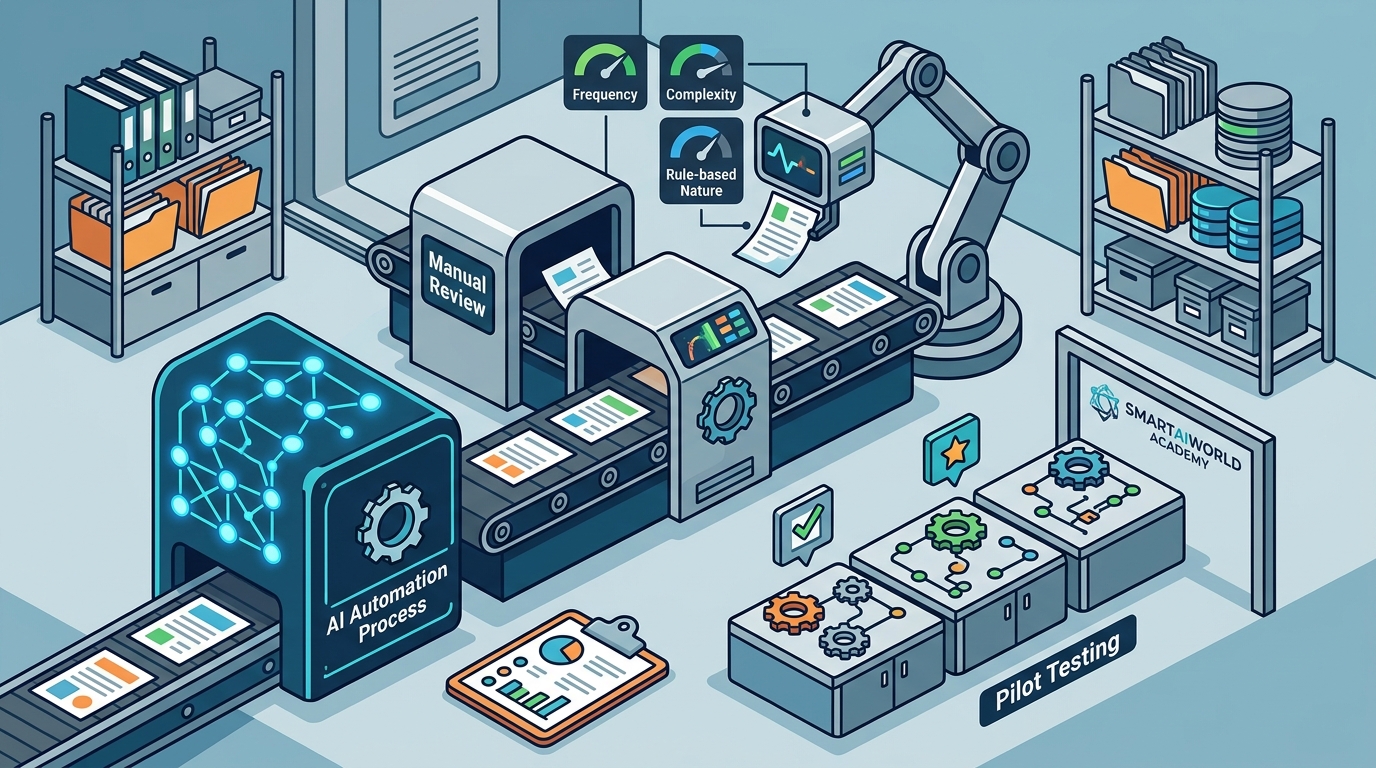
Identifying tasks worth automating with AI requires evaluating frequency, complexity, and data availability. You must determine if a task is repetitive, rule-based, and has clear success metrics. This guide covers the specific criteria for task evaluation and a structured pilot testing approach to validate AI workflows safely. For additional details, review the SmartAIWorld Practical AI Skills.
Task Evaluation Criteria
Not every task is a good candidate for AI. A task evaluation framework is a systematic method for assessing whether a specific job function can be improved by artificial intelligence. You need to look beyond the hype and focus on operational reality. The goal is to find tasks where AI adds value without introducing excessive risk or complexity. For additional details, review the Student Login SmartAIWorld Academy.
Frequency and Repetition
The most obvious indicator is how often you perform a task. If you do something every day or every week, it is a strong candidate. Repetition allows AI to learn patterns and reduce the time you spend on manual execution. However, frequency alone is not enough. A task that happens once a year is rarely worth the setup cost, even if it is tedious. For additional details, review the SmartAIWorld Pro Monthly AI.
Rule-Based vs. Creative Judgment
AI excels at tasks with clear rules and structured data. It struggles with high-level creative judgment or nuanced human empathy. You should classify tasks as either rule-based or judgment-based. Rule-based tasks, like data entry or formatting, are ideal for automation. Judgment-based tasks, like strategic planning, require human oversight. A hybrid approach often works best, where AI handles the draft and a human makes the final call. For additional details, review the Terms of Use SmartAIWorld.
Data Availability and Quality
AI systems need data to function. If your task relies on information that is scattered, unstructured, or private, AI may not be the right tool. You must assess whether the necessary inputs are easily accessible. If you spend more time cleaning data than doing the actual work, AI can help, but you must account for that initial setup. Poor data quality leads to poor AI output, a concept often referred to as garbage in, garbage out.
Pilot Testing Approach
Once you have identified candidate tasks, you must test them before full deployment. A pilot test is a small-scale trial run of an AI workflow in a real-world environment. This phase is critical for identifying edge cases and measuring actual time savings. It prevents you from wasting resources on tools that do not fit your specific needs.
Defining Success Metrics
Before you start, define what success looks like. Do you want to save time, reduce errors, or improve quality? You need specific, measurable goals. For example, if you are automating report generation, your metric might be reducing creation time from four hours to one hour. Without clear metrics, you cannot determine if the AI is actually helping or just adding noise.
Human-in-the-Loop Validation
Never remove human oversight entirely during the pilot phase. You should review every AI output during the initial testing period. This allows you to catch errors and refine your prompts. As confidence grows, you can reduce the review frequency. This gradual shift ensures quality control while still capturing efficiency gains. It is a safe way to build trust in the system.
Iterative Refinement
The first version of your AI workflow will rarely be perfect. You should expect to iterate. Adjust your prompts, change the tools, or modify the process based on the pilot results. Document what works and what does not. This documentation becomes valuable for future training and onboarding. It turns a one-off experiment into a repeatable skill.
Comparison of Task Types
| Task Type | AI Suitability | Key Consideration |
|---|---|---|
| Data Entry | High | Requires clean, structured input |
| Report Drafting | Medium | Needs human review for accuracy |
| Strategic Planning | Low | Relies on complex human judgment |
| Email Triage | High | Benefit from pattern recognition |
Key Takeaways
- Focus on tasks that are frequent and rule-based.
- Ensure you have access to clean, structured data.
- Define clear success metrics before starting a pilot.
- Keep humans in the loop during initial testing.
- Document your process to create repeatable workflows.
- Iterate based on real-world results, not assumptions.
- Use AI to assist, not replace, human judgment.
Frequently Asked Questions
What is the first step in evaluating a task for AI?
The first step is to document the current process. You need to understand exactly how the task is done today, including all manual steps and decision points. This baseline is essential for measuring improvement later.
How long should a pilot test last?
A pilot test should last long enough to cover a full cycle of the task. For daily tasks, two to four weeks is often sufficient. For monthly tasks, you may need to wait for the next occurrence. The goal is to see consistent results, not just a one-time success.
Can AI handle creative tasks?
AI can assist with creative tasks by generating ideas or drafts. However, it cannot replace human creativity or taste. You should use AI as a brainstorming partner, not a final decision-maker. The human must curate and refine the output.
What if the AI makes mistakes?
Mistakes are expected during the learning phase. You should treat errors as data. Analyze why the mistake happened and adjust your prompts or process accordingly. If errors are frequent and critical, the task may not be suitable for automation yet.
Do I need to be a programmer to use AI?
How do I measure the ROI of AI adoption?
Measure the time saved and multiply it by your hourly rate. Compare this to the cost of the AI tool. If the time saved exceeds the cost, you have a positive return on investment. You should also consider quality improvements, which are harder to quantify but still valuable.