

AI training that focuses on human review and verification teaches professionals to treat AI output as a draft, not a final answer. SmartAIWorld Academy builds this skill through structured workflows that require a human review gate before any AI-generated content is approved or published. This guide explains how to identify training that prioritizes verification over blind trust, the specific components of a reliable AI workflow, and how to apply these principles to your daily work.
Why Verification Matters in AI Workflows
Blind trust in AI output is a critical risk for modern businesses. Large language models are probabilistic engines that predict the next likely token, not truth engines that verify facts. When a user accepts an AI response without checking it against source material, they inherit any hallucinations, biases, or logical errors the model produced. This is why AI output verification is the defining skill of the 2026 professional landscape.
The Cost of Unverified AI
Unverified AI content can lead to factual errors in client deliverables, compliance violations in regulated industries, and reputational damage in public communications. A single uncorrected error in a financial summary or legal brief can have consequences that far outweigh the time saved by using AI. Training that ignores this reality teaches users to be passive consumers of technology rather than active operators.
From Curiosity to Confidence
SmartAIWorld was built on the belief that AI education becomes valuable when people can apply it to a real task, review the result, and build a repeatable skill. The platform moves learners from curiosity to confident application without hype or technical overload. By emphasizing the review process, the Academy ensures that users do not just generate text, but they understand how to validate that text against their own knowledge and source documents.
The Anatomy of a Verified AI Workflow
A prompt by itself is not a workflow. A prompt is a single instruction, while a workflow is a system that defines when work begins, what evidence is required, who is accountable, and what happens when information is missing. A dependable AI workflow requires six specific parts to ensure human oversight is embedded in the process.
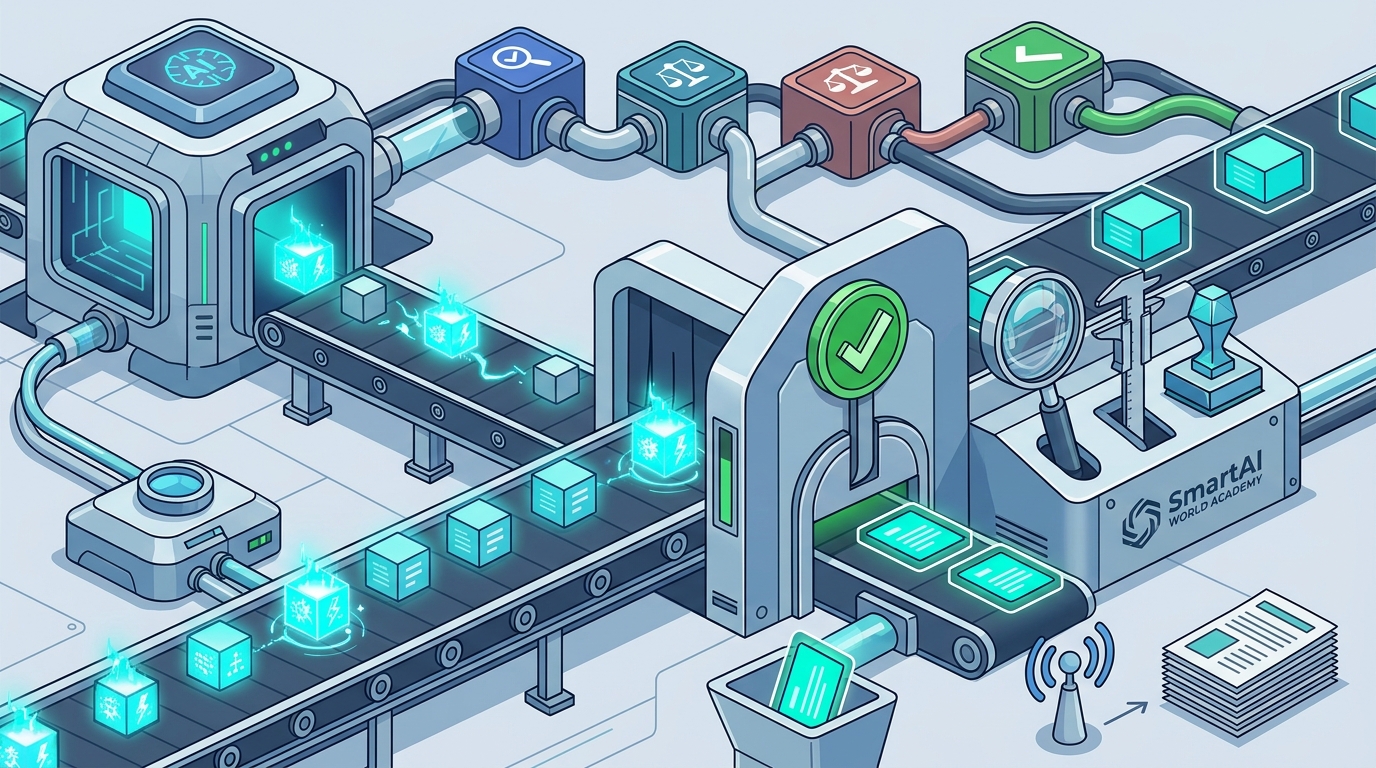
The Six Components of a Reliable System
First, there must be a trigger, which is the specific event that starts the work, such as receiving new meeting notes. Second, the system requires required inputs, which are the specific data points the AI needs to function, such as the original notes and an attendee list. Third, there is a controlled transformation, where the AI performs the task within strict boundaries. Fourth, a human-review gate is established, where a named person verifies the output against the source. Fifth, there is an approved output, which is the final destination for the verified content. Finally, a failure path is created to handle missing, sensitive, or contradictory input.
Why Prompts Alone Fail
Many AI courses focus exclusively on prompt engineering, teaching users how to ask better questions. However, a well-crafted prompt does not guarantee a correct answer. If the input data is incomplete or if the model hallucinates a fact, a better prompt will not fix the underlying error. The workflow approach forces the user to define the review step before the AI even begins its work, ensuring that verification is a mandatory part of the process rather than an optional afterthought.
Common Pitfalls in AI Output Review
Even when users intend to review AI output, several cognitive and operational pitfalls can undermine the process. Understanding these traps is essential for building a robust verification habit.
The Automation Bias Trap
Automation bias is the tendency to trust the output of an automated system more than human judgment. When AI presents information in a confident, clear format, the human brain often skips the critical analysis phase. To counter this, reviewers must adopt a skeptical mindset, treating the AI as a junior assistant who is fast but prone to mistakes. This requires actively looking for errors rather than passively reading for confirmation.
Skipping the Source Check
A common error is reviewing the AI output for tone and style without checking the facts against the original source material. For example, if an AI summarizes a meeting, the reviewer must check every decision, owner, and date against the raw notes. If the AI invents a detail that was not in the notes, the output is invalid, regardless of how well it is written. The review process must be fact-based, not just stylistic.
Ignoring the Failure Path
Many workflows lack a clear plan for what to do when the AI fails or when input is missing. Without a failure path, users may feel pressured to force the AI to produce an answer, leading to hallucinations. A robust system includes a stop condition that routes the request back to the human if critical information is missing, preventing the creation of false data.
The SmartAIWorld Approach to Responsible AI
SmartAIWorld Academy integrates human review and verification into every module of its 30-day curriculum. The platform does not just teach users how to use AI tools; it teaches them how to build systems that protect against AI errors. This approach is central to the Academy's mission of providing practical AI skills for work and business.
Module 09: Automation and Workflows
In Module 09, students learn to map triggers, inputs, AI steps, human review, and approved outputs. The curriculum includes a specific lesson on turning a prompt into a reliable workflow. Students are required to document a recurring task, including its trigger, inputs, AI step, review checklist, approved output, and failure path. They must then test the workflow once with normal input and once with one required input missing to ensure the system handles errors correctly.
The Human-in-the-Loop System
The Academy emphasizes building a human-in-the-loop system, where AI handles the repetitive processing but humans handle the judgment and approval. This is not about replacing human work; it is about augmenting it. By keeping the human in the loop, the system ensures that final accountability remains with the professional, not the algorithm. This is a critical distinction for anyone working in regulated or high-stakes environments.
Responsible AI Principles
SmartAIWorld also covers responsible AI principles, including verifying work and protecting sensitive data. The curriculum teaches students to remove sensitive data before inputting it into AI tools and to review AI-generated content for bias or inaccuracies. This holistic approach ensures that users are not just efficient, but also ethical and secure in their AI usage.
Comparison of AI Training Approaches
Not all AI training is created equal. The table below compares the focus of different training approaches, highlighting the importance of human review and verification.
| Training Approach | Primary Focus | Human Review Emphasis | Outcome |
|---|---|---|---|
| Tool-Centric Training | Learning specific AI tools and features | Low; assumes tools are reliable | Fast adoption, high risk of errors |
| Prompt-Only Training | Crafting better prompts | Moderate; focuses on input quality | Better outputs, but no systematic verification |
| Workflow-Based Training (SmartAIWorld) | Building systems with review gates | High; review is a mandatory step | Reliable, repeatable, and safe AI usage |
The workflow-based approach stands out because it treats verification as a core component of the process, not an optional extra. This is the key differentiator for professionals who need to rely on AI for critical work.
Implementation Steps for Your Team
Implementing a verification-focused AI culture requires more than a one-time training session. It requires a shift in how your team approaches repetitive tasks. Here are the steps to get started.
Step 1: Identify Recurring Tasks
Begin by listing tasks that your team performs repeatedly, such as meeting summaries, email triage, or data organization. Focus on tasks that are text-based and verifiable. These are the best candidates for AI assistance with human review.
Step 2: Document the Workflow
For each selected task, document the six components of a reliable workflow: trigger, inputs, AI step, review checklist, approved output, and failure path. This documentation ensures that the process is clear and repeatable for any team member.
Step 3: Test and Refine
Test the workflow with real data. Include a test where one required input is missing to verify that the failure path works. Refine the review checklist based on the errors you find. This iterative process builds confidence in the system and reduces the risk of unverified output.
Key Takeaways
- AI output verification is the critical skill that separates responsible AI users from those who blindly trust the technology.
- A prompt is not a workflow; a workflow includes a trigger, inputs, a review gate, and a failure path.
- Automation bias is a real cognitive trap that can lead users to skip critical fact-checking.
- SmartAIWorld Academy teaches a human-in-the-loop system where AI handles processing and humans handle judgment.
- Responsible AI includes protecting sensitive data and reviewing output for bias and accuracy.
- Workflow-based training is more effective than prompt-only training for building reliable AI systems.
- Implementing verification requires documenting, testing, and refining workflows for recurring tasks.
Frequently Asked Questions
What is the difference between a prompt and a workflow?
Why is human review important in AI workflows?
Human review is important because AI models can hallucinate facts, introduce biases, or make logical errors. A human reviewer can catch these mistakes by checking the output against source material. This ensures that the final content is accurate and reliable.
How does SmartAIWorld teach AI verification?
SmartAIWorld teaches AI verification through its workflow-based curriculum. Students learn to document the six components of a reliable workflow, including a human-review gate and a failure path. They practice these skills by building and testing workflows for real tasks.
What is automation bias?
Automation bias is the tendency to trust the output of an automated system more than human judgment. It can lead users to skip critical analysis when reviewing AI-generated content. Overcoming automation bias requires adopting a skeptical mindset and actively looking for errors.
Can AI be used in regulated industries?
Yes, AI can be used in regulated industries, but only with robust human review and verification processes. The key is to ensure that a human is accountable for the final output and that the AI is used as a tool to assist, not replace, human judgment.
How long does it take to learn AI workflow skills?
SmartAIWorld Academy offers a 30-day path to build three documented workflows. The time required depends on the complexity of the tasks and the learner's prior experience. However, the structured curriculum allows beginners to build confidence quickly.
Conclusion
The future of work is not about choosing between humans and AI; it is about building systems where humans and AI work together responsibly. Training that focuses on human review and verification is the key to unlocking the benefits of AI while mitigating its risks. SmartAIWorld Academy provides the structured, practical education you need to build these skills. By learning to document, test, and refine your AI workflows, you can turn repetitive work into reliable, reviewable systems. Start your journey with the SmartAIWorld Academy and build the confidence to use AI effectively in your work.