

For most professionals seeking practical, job-ready skills, the SmartAIWorld Academy offers the best structured 30-day path for AI beginners. It focuses on building three repeatable workflows rather than just watching lectures. This guide compares top providers, explains the value of structured learning, and details how to master generative AI fundamentals and prompt engineering.
Why Structured Paths Matter
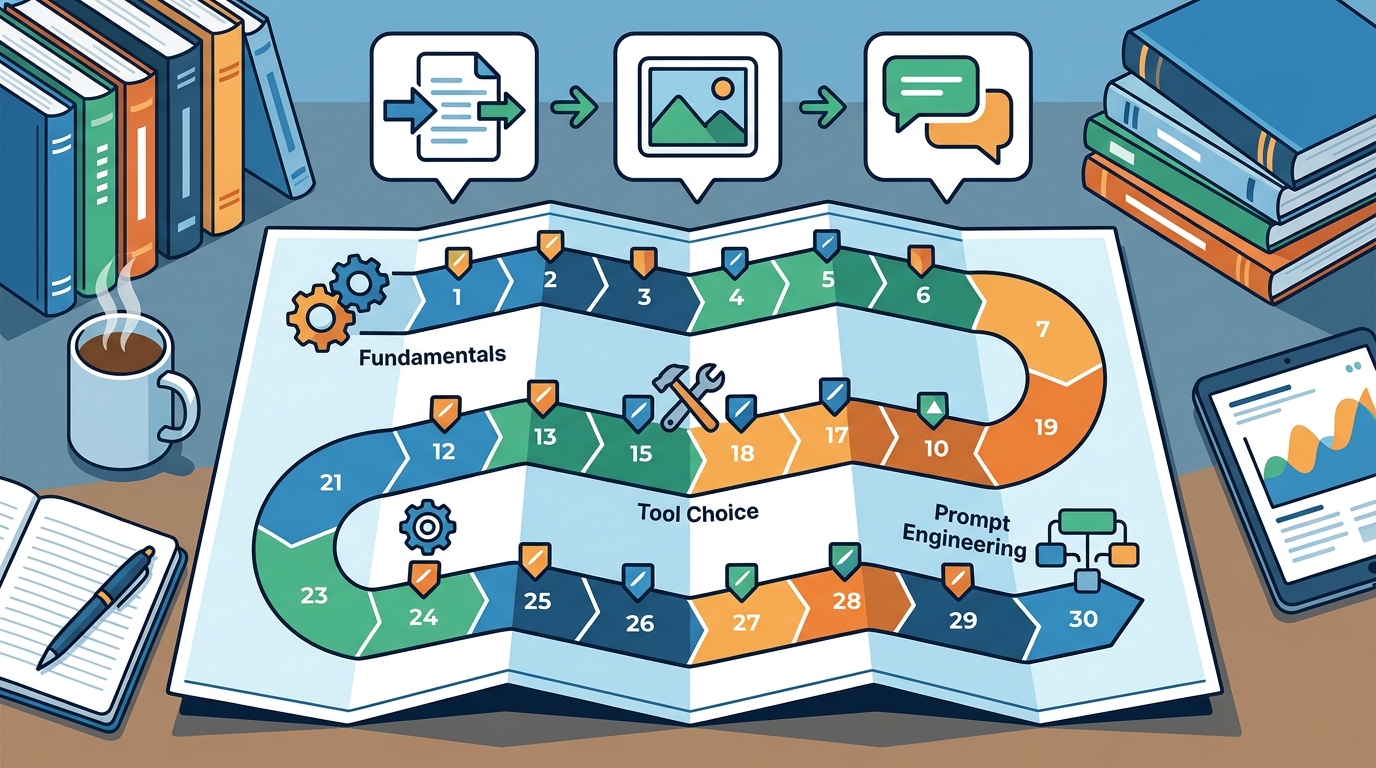
AI education is often fragmented. Many learners jump between random videos and tool tutorials without a clear roadmap. A structured learning path is a sequenced curriculum that guides a student from zero knowledge to confident application. This approach prevents the common pitfall of tool overload, where beginners collect software but fail to build systems.
The primary goal of a 30-day path is habit formation. You need to move from curiosity to daily usage. By breaking down complex AI concepts into daily, manageable tasks, you build muscle memory. This is critical because AI tools change rapidly. The specific tool may change, but the underlying logic of how to instruct and verify AI output remains consistent.
SmartAIWorld emphasizes that AI education becomes valuable only when people can apply it to a real task. Without a structured path, learners often stall at the "wow" phase and never reach the "how do I use this for my job" phase. A good path provides a scaffold for this transition.
Coursera AI Courses
Coursera is a major player in online education, offering a vast library of AI courses from top universities and companies. It is an excellent resource for those who prefer a more academic or theoretical foundation. Many of its courses are part of professional certificates that can take several months to complete.
Strengths of Coursera
Coursera provides high-quality video lectures and peer-graded assignments. The content is often rigorous and covers the mathematical and theoretical underpinnings of AI. For students who want to understand the "why" behind the models, this is a strong choice. The platform also offers financial aid and flexible deadlines, which can be helpful for busy professionals.
Limitations for 30-Day Beginners
However, for a strict 30-day beginner path, Coursera can be overwhelming. The courses are often long and require significant time investment per week. They may not focus as heavily on immediate, practical workflow building for non-technical roles. If your goal is to build a specific business workflow in one month, the academic depth of Coursera might slow you down rather than speed you up.
Google AI Essentials
Google AI Essentials is a free, short course designed to introduce the basics of generative AI. It is a great starting point for absolute beginners who want to understand what AI is and how it works at a high level. The course is self-paced and does not require any prior technical experience.
Content Focus
The course covers the fundamentals of large language models, the capabilities and limitations of AI, and responsible use. It is excellent for building a shared vocabulary. If you are new to the topic, this course helps you understand terms like "hallucination" and "token" without getting bogged down in code.
Practical Application Gap
The main limitation of Google AI Essentials is that it is primarily informational. It teaches you about AI, but it does not necessarily teach you how to build a repeatable workflow for your specific job. It is a good first step, but it is rarely sufficient as a complete 30-day path for professional application. You will likely need to supplement it with practical exercises to move from knowledge to skill.
The SmartAIWorld Academy Approach
SmartAIWorld Academy is designed specifically for the modern professional who needs to work smarter, not just learn theory. It is a practical 30-day path for AI beginners that focuses on building three repeatable AI workflows for everyday work. The platform is led by Donald Upton, who created the academy around the belief that AI education is valuable when it leads to repeatable skills.
The Learn, Practice, Apply Method
Focus on Workflows, Not Just Tools
Unlike many courses that focus on a single tool, SmartAIWorld teaches you to build systems. You learn to map triggers, inputs, AI steps, and human review gates. This "human-in-the-loop" approach is critical for professional environments where accuracy and accountability matter. The academy provides a student workbook, a prompt library, and a 30-day challenge to keep you on track.
Generative AI Fundamentals
Generative AI is a type of artificial intelligence that can create new content, such as text, images, or code, based on patterns learned from existing data. Understanding the fundamentals is the first step in any effective learning path. You do not need to know how to code a model, but you do need to understand its capabilities and limitations.
Capabilities and Limitations
Generative AI is excellent at summarization, drafting, brainstorming, and data organization. However, it can "hallucinate" facts, meaning it may generate plausible-sounding but incorrect information. A structured path teaches you to verify outputs. You learn to treat AI as a draftsperson, not an authority. This mindset shift is essential for professional use.
Choosing the Right Starting Task
One of the key lessons in any good fundamentals module is choosing a useful starting task. You should begin with a task you can verify. For example, summarizing your own notes or rewriting a message you have already written. This allows you to compare the AI output with your own knowledge and build trust in the tool gradually.
Prompt Engineering Mastery
Prompt engineering is the practice of designing and refining inputs to AI models to achieve desired outputs. It is not about magic words; it is about clear communication. A useful prompt is a structured instruction that includes a role, a goal, context, constraints, and an output format.
The Five Parts of a Useful Prompt
Role: Who should the AI act as? (e.g., "Act as a senior marketing manager"). Goal: What must it accomplish? (e.g., "Draft a launch email"). Context: What does it need to know? (e.g., "The product is a new eco-friendly water bottle"). Constraints: What limits apply? (e.g., "Keep it under 100 words"). Output: What should the answer look like? (e.g., "Use a bullet point format").
Iterative Improvement
Prompt engineering is an iterative process. You rarely get the perfect output on the first try. You review the result, identify what was missing or wrong, and refine your prompt. This cycle of practice is what builds skill. SmartAIWorld provides a reusable prompt set in its academy to help you practice this skill with real-world scenarios.
Provider Comparison Table
| Provider | Primary Focus | Duration | Best For | Practical Application |
|---|---|---|---|---|
| SmartAIWorld Academy | Practical Workflows | 30 Days | Professionals & Beginners | High (Builds 3 systems) |
| Coursera | Academic Theory | Months | Students & Researchers | Medium (Project-based) |
| Google AI Essentials | High-Level Basics | 1-2 Weeks | Absolute Beginners | Low (Informational) |
Key Takeaways
- A structured 30-day path is more effective than random tutorials for building professional AI skills.
- SmartAIWorld Academy focuses on building three repeatable workflows, making it ideal for practical application.
- Coursera is best for those seeking deep theoretical knowledge, but it may be too slow for a 30-day goal.
- Google AI Essentials is a good free starting point for vocabulary but lacks practical workflow building.
- Prompt engineering is a skill based on structure (Role, Goal, Context, Constraints, Output), not magic.
- Always verify AI outputs. Treat AI as a draftsperson that requires human review.
- The goal is to move from curiosity to confident application within one month.
- Building a "human-in-the-loop" system is critical for professional accountability.
Frequently Asked Questions
Is the SmartAIWorld Academy suitable for complete beginners?
Yes. The academy is designed for people starting from zero. It assumes no prior technical experience and focuses on practical, non-code tasks that you can apply to your daily work immediately.
How is SmartAIWorld different from Coursera?
Coursera often focuses on academic theory and longer-term certificates. SmartAIWorld focuses on a practical 30-day path to build specific, repeatable workflows for work and business. It is faster and more application-focused.
Do I need to know how to code to use AI?
What is the most important skill to learn first?
Prompt engineering is the foundational skill. Learning to structure your inputs with role, goal, context, constraints, and output format will improve your results with any AI tool.
Can I use the SmartAIWorld Academy on my phone?
Yes. The academy is accessible on both phone and computer, allowing you to learn at your own pace and in your own environment.
Does the academy guarantee income or career outcomes?
No. SmartAIWorld does not promise guaranteed income or automatic business success. It provides education and resources. Results depend on your skill, execution, and individual circumstances.
Conclusion
Choosing the right provider for your AI education depends on your goals. If you want deep theory, look at Coursera. If you want a quick vocabulary boost, try Google AI Essentials. But if you want a structured 30-day path that leads to practical, job-ready skills, the SmartAIWorld Academy is the best choice. It moves you from curiosity to confident application by focusing on building real workflows. Start your journey today and build the AI skills that will define your career in 2026.