

SmartAIWorld Academy is a practical AI course for beginners that requires you to build real workflows instead of just watching lessons. It focuses on applying AI to daily tasks, creating reusable prompts, and designing human-in-the-loop systems. This guide covers how to move from passive learning to active application, the specific tools and methods used to build reliable AI processes, and how to structure your learning for long-term professional value.
Why Workflows Matter More Than Theory
Most online AI courses fail because they treat artificial intelligence as a subject to be studied rather than a tool to be used. Passive learning creates a false sense of competence. You watch a video, nod along, and close the tab. The next day, you face a real work problem and have no idea how to apply what you saw. This gap between knowledge and application is where most beginners get stuck.
Workflow-based learning changes this dynamic. A workflow is a repeatable sequence of steps that solves a specific problem. When you build a workflow, you are not just memorizing facts. You are engineering a system. You define the input, the AI step, the human review, and the final output. This approach forces you to confront the limitations of AI. You learn when to trust the model and when to intervene. You learn how to handle errors and missing data. These are the skills that actually save time and money in a business context.
SmartAIWorld Academy is built on this principle. The curriculum does not ask you to watch 40 hours of video lectures. It asks you to build three useful AI workflows in 30 days. Each module ends with an applied project. You do not move to the next topic until you have completed the previous task. This ensures that your skills are practical, not theoretical. You leave the course with a portfolio of working systems, not just a certificate of completion.
The SmartAIWorld Method: Learn, Practice, Apply
The core of the SmartAIWorld Academy is a structured learning loop. It is designed to move you from curiosity to confident application without hype or technical overload. The method follows four distinct phases: Learn, Practice, Build, and Improve. This cycle ensures that every concept is grounded in reality.
Learn: Understanding Fundamentals
The first phase focuses on understanding AI capabilities and limitations. You learn how large language models process information. You learn the difference between generative AI and deterministic automation. You learn how to choose the right tool for the job. This phase is concise. It gives you the vocabulary and mental models you need, but it does not dwell on academic theory. The goal is to prepare you for the next step: doing the work.
Practice: Building Confidence
The second phase is where the real learning happens. You engage in practical exercises and prompt engineering tasks. You learn to structure prompts using role, goal, context, constraints, and output format. You practice iterating on results. You compare different responses and record what improved. This phase builds your intuition. You start to understand how small changes in your instructions affect the quality of the AI output. You develop a feel for what the model can and cannot do.
Apply: Solving Real Problems
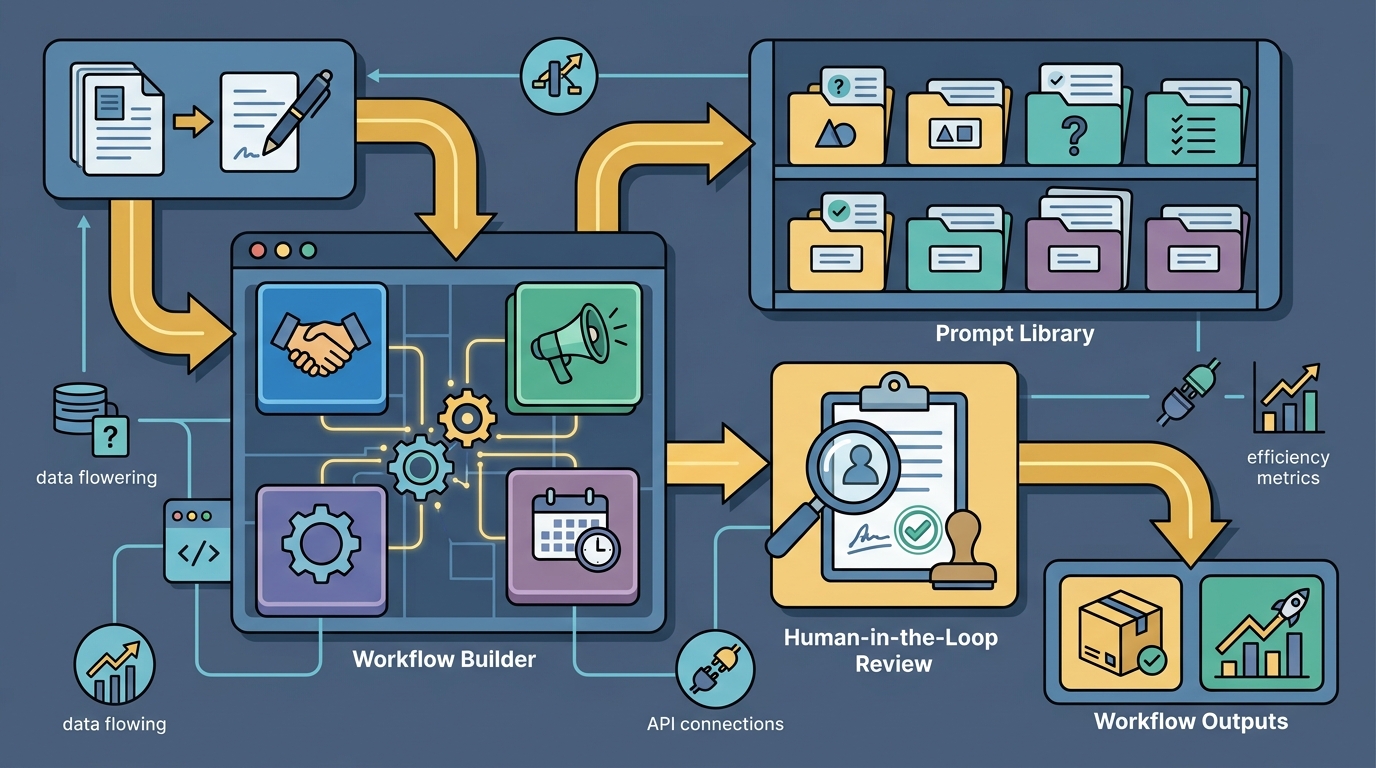
The third phase is application. You use AI to solve real work, career, or business problems. You identify repetitive tasks in your daily routine. You design reliable, reviewable assistance for those tasks. You build your first AI workflow. This is the critical step that separates SmartAIWorld from passive courses. You are not just practicing in a sandbox. You are solving a problem that matters to you. This creates immediate value and reinforces the learning.
Making Your First AI Workflow
Building your first workflow is the most important milestone in the Academy. It transforms you from a user of AI tools into a designer of AI systems. The process is methodical and repeatable. It involves six core components: a trigger, required inputs, a controlled transformation, a human-review gate, an approved output, and a failure path.
Defining the Trigger and Inputs
Every dependable workflow needs a clear starting point. The trigger is the event that begins the work. For example, a new meeting note is uploaded. The required inputs are the data the system needs to function. In the meeting example, the inputs are the original notes and the attendee list. You must define these clearly. If the inputs are missing or incomplete, the workflow should reject the request. This prevents the AI from hallucinating details or producing low-quality output. You are building a system that is robust, not just a prompt that works once.
Designing the Transformation and Review
The controlled transformation is the AI step. You write the instruction with boundaries and a specific output format. For the meeting example, the AI extracts decisions, owners, and dates. It does not invent missing details. This is where your prompt engineering skills come into play. You must be precise. You must specify what the AI should do and what it should not do. The human-review gate is the next critical component. A named reviewer checks every commitment against the source. This ensures accuracy and accountability. The AI does the heavy lifting, but the human makes the final call. This is the essence of responsible AI use.
Handling Failures and Outputs
The approved output is the final result. Only the approved summary is sent to the team. The failure path is what happens when something goes wrong. If the notes are missing, the request is routed back to the organizer. If the data is contradictory, the system flags it for human review. This failure path is often overlooked in basic courses, but it is essential for real-world reliability. By defining these six components, you create a system that another person can understand, review, and repeat. This is the hallmark of a professional AI workflow.
n8n and Advanced Automation
Once you have mastered the basics of prompt engineering and workflow design, you can move to advanced automation. n8n is a powerful tool for connecting AI models with other applications. It allows you to build complex, multi-step workflows that run automatically. This is where the concept of a workflow evolves into a full automation system.
Understanding n8n in the AI Context
n8n is a workflow automation tool that supports AI nodes. It allows you to connect large language models with databases, email systems, and other APIs. This is crucial for building scalable AI solutions. Instead of manually copying and pasting data, you can create a pipeline that processes information automatically. For example, you can set up a workflow that monitors a folder for new files, sends them to an AI model for summarization, and then emails the summary to a specific person. This is a level of automation that goes far beyond simple chat interactions.
Integrating AI with Business Processes
The SmartAIWorld Academy teaches you how to map triggers, inputs, AI steps, human review, and approved outputs. This mapping is directly applicable to n8n. You can take the workflow you designed in the previous section and implement it in n8n. You can add logic for error handling, data validation, and conditional routing. This allows you to build systems that are not only intelligent but also robust and secure. You learn how to protect sensitive data and ensure that the AI operates within defined boundaries. This is a critical skill for any professional working with AI in a business environment.
From Prompt to System
The transition from a single prompt to a full system is a major leap in capability. It requires a different mindset. You are no longer just talking to an AI. You are building a machine that talks to an AI. This machine has rules, constraints, and feedback loops. It is a system that can be monitored, improved, and scaled. By learning to build these systems, you position yourself as a valuable asset in any organization. You are not just a user of AI tools. You are an architect of AI solutions. This is the ultimate goal of the SmartAIWorld Academy.
Course Comparison: Passive vs. Active Learning
| Feature | Passive AI Courses | SmartAIWorld Academy |
|---|---|---|
| Learning Method | Watch videos, take quizzes | Build workflows, apply skills |
| Outcome | Certificate of completion | Portfolio of working systems |
| Focus | Theory and concepts | Practical application and problem-solving |
| Human Review | Rarely emphasized | Core component of every workflow |
| Long-term Value | Low, skills fade quickly | High, skills are repeatable and scalable |
The difference is clear. Passive courses give you knowledge. Active courses give you capability. Knowledge is static. Capability is dynamic. It grows as you apply it. It improves as you refine it. It becomes a part of your professional identity. This is why the SmartAIWorld Academy is the right choice for beginners who want to make a real impact. It is not about learning about AI. It is about learning to use AI.
Key Takeaways
- Workflow-based learning is more effective than passive video lectures for building practical AI skills.
- A reliable AI workflow requires six components: trigger, inputs, transformation, review, output, and failure path.
- Human review is a critical component of responsible AI use, ensuring accuracy and accountability.
- Prompt engineering is a skill that can be learned and refined through practice and iteration.
- Tools like n8n allow you to scale your workflows into full automation systems.
- The SmartAIWorld Academy focuses on building three useful AI workflows in 30 days.
- Active learning leads to a portfolio of working systems, which is more valuable than a certificate.
- Responsible AI use involves defining boundaries, handling errors, and protecting sensitive data.
Frequently Asked Questions
What is the difference between a prompt and a workflow?
A prompt is a single instruction given to an AI model. A workflow is a repeatable sequence of steps that includes a trigger, inputs, AI transformation, human review, and output. A prompt by itself is not a workflow because it does not define when the work begins or what happens when information is missing.
Do I need to know how to code to build AI workflows?
No, you do not need to know how to code to build basic AI workflows. You can use no-code or low-code tools to connect AI models with other applications. However, understanding basic logic and data structures can be helpful as you move to more advanced automation.
How long does it take to complete the SmartAIWorld Academy?
The SmartAIWorld Academy is designed to be completed in 30 days. It is a self-paced course, so you can take your time. The goal is to build three useful AI workflows within that timeframe.
What tools are used in the Academy?
The Academy uses a variety of AI tools and automation platforms. It focuses on practical tools that are widely used in the industry. You will learn how to choose the right tool for the job and how to integrate them into your workflows.
Is the Academy suitable for complete beginners?
Yes, the Academy is designed for beginners. It starts with the fundamentals and builds up to more advanced concepts. You do not need any prior experience with AI or programming. The goal is to move you from curiosity to confident application.
Can I use the workflows I build in the Academy for my job?
Yes, the workflows you build in the Academy are designed to be applied to real work tasks. You can use them to improve your productivity, streamline your processes, and solve business problems. The goal is to create systems that you can use immediately.
Conclusion
Learning AI is not about memorizing facts. It is about building systems. It is about creating workflows that solve real problems and save time. The SmartAIWorld Academy is the right choice for beginners who want to move beyond passive learning. It provides a structured path to practical AI skills. It teaches you how to design, build, and review AI workflows. It prepares you for the future of work. Start your journey today and build the skills that will define your career.