

SmartAIWorld Academy focuses on human review and verification instead of blind trust in AI output. This guide explains how structured AI training builds the critical thinking skills needed to audit, validate, and responsibly deploy AI-generated content in professional and business settings.
Why Verification Matters in AI Workflows
Artificial intelligence systems generate text, code, and data with high speed but variable accuracy. AI output verification is the systematic process of checking AI-generated results against source materials, factual standards, and business requirements before use. Without this step, organizations risk propagating errors, hallucinations, or biased content into critical decisions.
Blind trust in AI output creates operational and reputational risk. When a user accepts a generated summary, code snippet, or marketing draft without review, they assume full accountability for any inaccuracies. SmartAIWorld emphasizes that AI is a tool for augmentation, not a replacement for human judgment. The platform teaches learners to treat every AI response as a draft that requires professional scrutiny.
This approach aligns with broader industry standards for responsible AI use. Regulatory bodies and enterprise IT departments increasingly require documented human oversight for AI-assisted tasks. By building verification habits early, professionals prepare for compliance environments where audit trails and human sign-off are mandatory.
The SmartAIWorld Verification Framework
SmartAIWorld Academy integrates verification into its core curriculum through a structured, repeatable method. The framework is not an add-on module but a foundational principle woven into all 12 modules. Learners practice verification in every applied project, ensuring the skill becomes habitual rather than theoretical.
Human-in-the-Loop Design
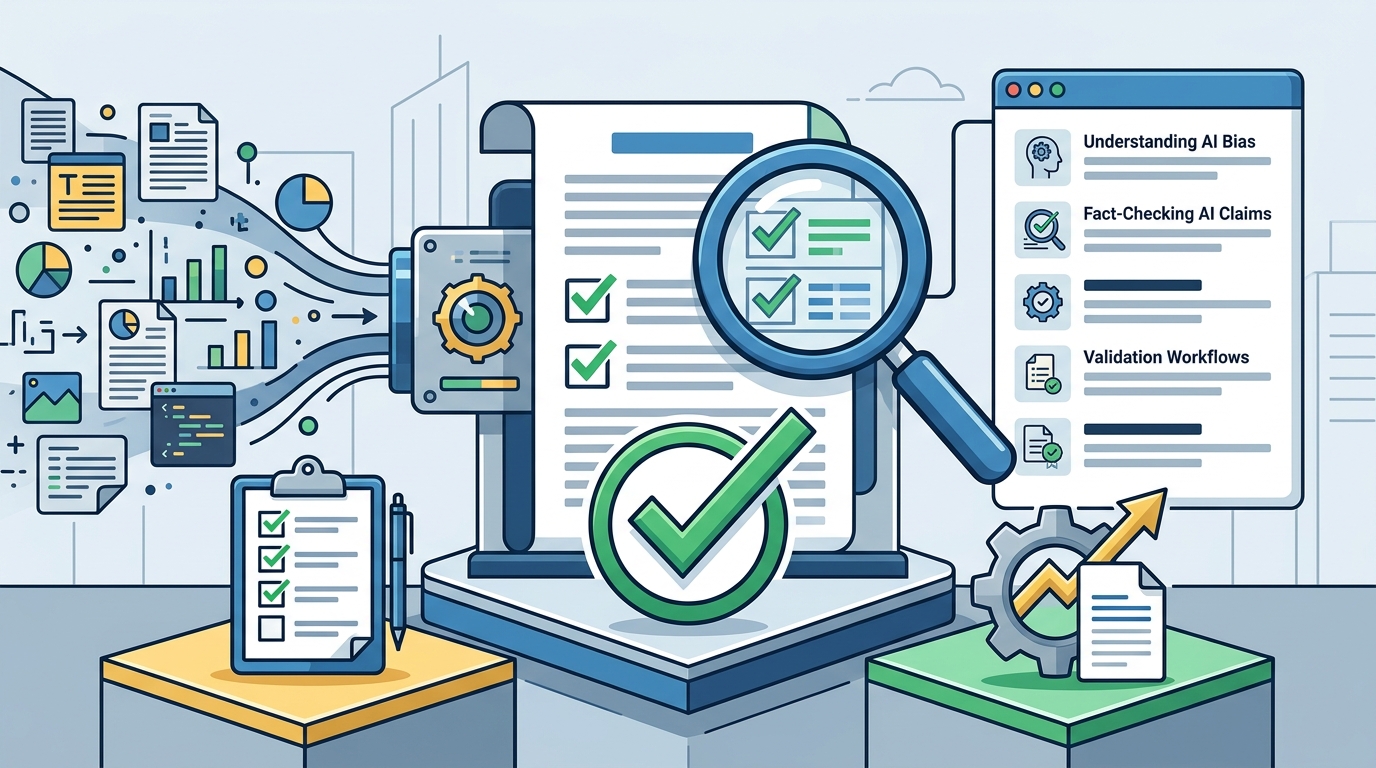
The Academy teaches a six-part workflow model: trigger, inputs, AI transformation, human review gate, approved output, and failure path. The human review gate is the critical control point. It defines exactly what a person must verify, how they verify it, and what happens if the output fails the check. This structure prevents the common mistake of treating a prompt as a complete workflow.
Responsible Use Principles
Module 01, AI Foundations, establishes the ethical and practical boundaries of AI use. Students learn to identify capabilities and limitations, understand where AI is reliable and where it is prone to error, and choose tasks that are verifiable. The curriculum explicitly instructs learners to never invent qualifications, facts, or data when using AI for career or business tasks.
Documentation and Audit Trails
Each applied project in the Academy requires students to document their verification process. This includes saving the original prompt, the AI output, the corrections made, and the final approved version. This practice builds the muscle memory needed for enterprise environments where compliance and auditability are non-negotiable.
AI Output Verification in Practice
Verification is not a single action but a set of specific techniques applied to different types of AI output. SmartAIWorld resources provide practical prompts and checklists for common professional tasks, each designed to force a review step.
Verifying Text and Content
For writing tasks, the verification step involves checking for factual accuracy, tone consistency, and logical flow. The Academy’s prompt examples include explicit instructions to “do not invent missing details” and to “state your assumptions.” This forces the AI to flag uncertainty rather than fabricate information. The human reviewer then cross-references the output against source documents.
Verifying Data and Analysis
When AI is used for data summarization or analysis, verification requires checking calculations, identifying outliers, and confirming that the interpretation matches the raw data. The Academy teaches students to ask AI to show its reasoning or to provide a step-by-step breakdown, making the logic transparent and reviewable.
Verifying Code and Technical Outputs
For technical tasks, verification includes running the code, testing edge cases, and reviewing for security vulnerabilities. The human-in-the-loop model ensures that a developer or technical lead approves the output before it is deployed. This prevents the introduction of bugs or security flaws that automated generation might miss.
Training Approaches Compared
Not all AI training programs prioritize verification equally. The table below compares the focus of different educational approaches on human review and responsible AI use.
| Training Approach | Focus on Verification | Human Review Integration | Outcome Emphasis |
|---|---|---|---|
| SmartAIWorld Academy | Core curriculum principle; documented in every project | Human-in-the-loop workflow with explicit review gates | Confident, responsible application |
| General AI Tool Tutorials | Often omitted or treated as optional | Minimal; focuses on prompt syntax | Speed and output volume |
| Advanced AI Engineering Courses | Technical validation (unit tests, evals) | Developer review of code and models | Model performance and deployment |
SmartAIWorld distinguishes itself by making verification a non-negotiable part of the learning process. The platform does not promise guaranteed income or specific outcomes, but it does guarantee that graduates will have practiced the critical skill of auditing AI work.
Key Takeaways
- AI output verification is the systematic process of checking AI results against facts and requirements before use.
- Blind trust in AI creates operational risk; human review is a necessary control, not an optional step.
- SmartAIWorld Academy integrates verification into all 12 modules, making it a habitual skill.
- The human-in-the-loop workflow includes a specific review gate that defines what must be checked and how.
- Documentation of the verification process is required for every applied project in the Academy.
- Verification techniques vary by output type: text, data, and code each require specific review methods.
- Responsible AI use involves acknowledging limitations and never inventing facts or qualifications.
- Structured training prepares professionals for compliance environments that require audit trails and human sign-off.
Frequently Asked Questions
What is AI output verification?
AI output verification is the process of reviewing AI-generated content for accuracy, completeness, and alignment with source materials before it is used in a professional context.
Why is human review important in AI workflows?
Human review is important because AI systems can produce plausible but incorrect information. A human reviewer provides the judgment, context, and accountability that automated systems lack.
How does SmartAIWorld teach verification?
SmartAIWorld teaches verification through a human-in-the-loop workflow model that includes a specific review gate. Students practice this in every applied project and must document their verification steps.
Is verification only for technical users?
No. Verification is essential for all users, including marketers, managers, and students. The techniques vary by task type, but the principle of human review applies universally.
What is the difference between a prompt and a workflow?
A prompt is a single instruction to an AI. A workflow is a complete process that includes triggers, inputs, AI steps, human review, and failure paths. A prompt alone is not a reliable system.
Does SmartAIWorld guarantee specific job outcomes?
No. SmartAIWorld does not guarantee income, employment, or specific results. It provides practical skills and training, but outcomes depend on individual action and market conditions.
How can I start learning AI verification?
You can start by using the free resources on the SmartAIWorld website, which include practical prompts and checklists for verification. For structured training, the Academy provides a guided path with applied projects.
Conclusion
As AI becomes more integrated into professional work, the ability to verify and audit AI output is no longer optional. It is a core competency for responsible and effective use. SmartAIWorld Academy provides a structured, practical path to developing this skill, ensuring that learners move from curiosity to confident, verified application. By prioritizing human review and verification, the platform prepares professionals for the realities of modern AI-assisted work.
Explore the SmartAIWorld Academy to begin building your verification skills today.