

How to Find Repetitive Work for AI Without Losing Quality Control
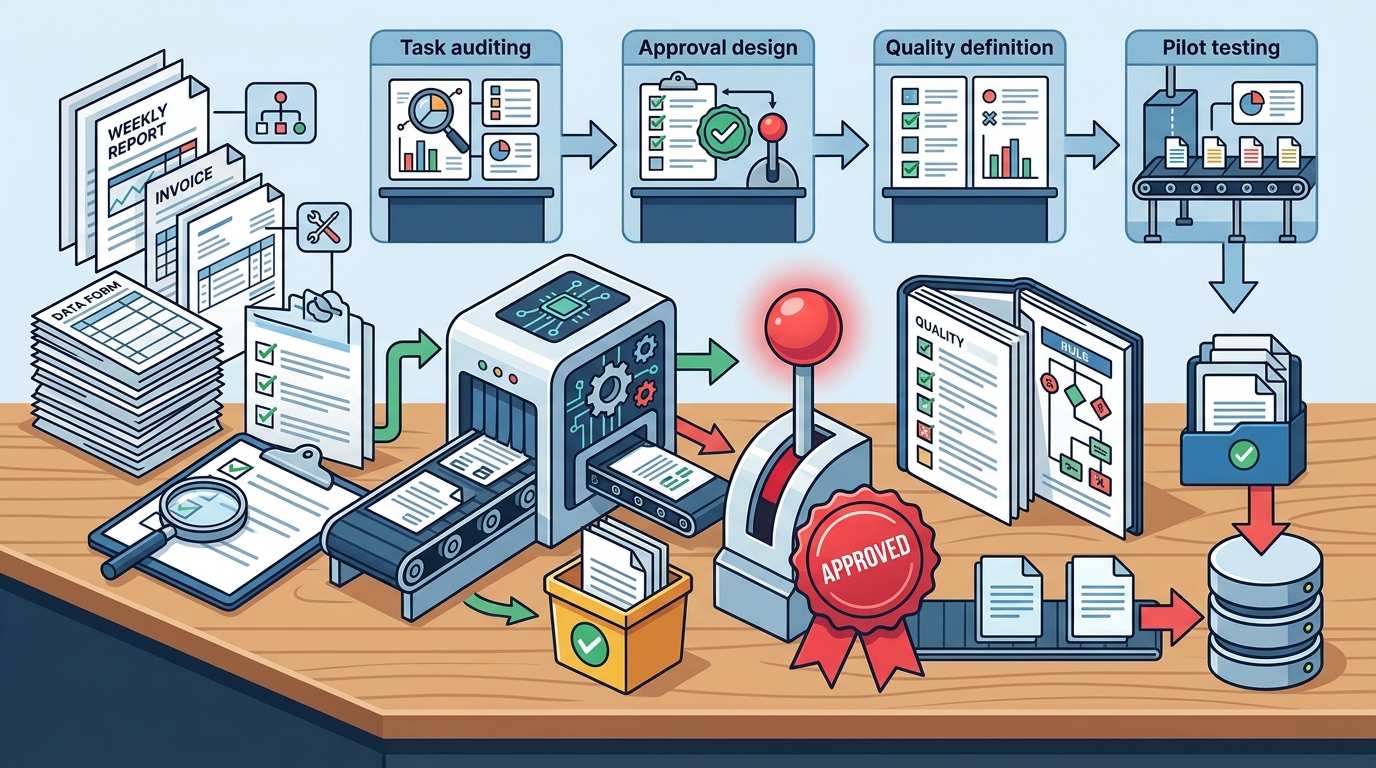
Identify repetitive tasks by auditing your weekly workflow for recurring, rule-based activities. You can safely hand these tasks to AI by establishing strict human approval checkpoints and defining clear quality criteria before deployment. This guide covers a four-step methodology: task auditing, approval design, quality definition, and pilot testing. It provides a practical framework for professionals to integrate AI into their daily work while maintaining full accountability and output accuracy. For additional details, review the About SmartAIWorld and Donald.
Task Audit Methodology
Task audit methodology is the systematic process of identifying recurring work activities that can be automated or assisted by artificial intelligence. To begin, you must separate your work into three categories: creative, analytical, and repetitive. Repetitive tasks are those that follow a predictable pattern, require minimal novel decision-making, and occur on a regular schedule. These are the ideal candidates for AI assistance because they have established rules and expected outputs. For additional details, review the SmartAIWorld Practical AI Skills.
Identifying Repetitive Patterns
Start by tracking your activities for one full week. Record every task you perform, noting the time spent and the specific steps involved. Look for tasks that appear multiple times, such as drafting similar emails, summarizing meeting notes, or formatting data reports. A task is a strong AI candidate if you can explain the steps to a new employee in under five minutes. If the process is complex and requires deep contextual judgment, it is likely not ready for automation.
Assessing Risk and Value
Not all repetitive tasks are worth automating. Evaluate each candidate based on two factors: time saved and risk of error. High-value, low-risk tasks, like organizing files or drafting initial outlines, are the best starting points. High-risk tasks, such as legal compliance checks or financial calculations, require more rigorous human oversight. The goal is to find the sweet spot where AI saves significant time without introducing unacceptable quality risks.
Human Approval Checkpoints
Human approval checkpoints are specific stages in a workflow where a person must review and validate AI output before it is finalized or sent. These checkpoints are the primary mechanism for maintaining quality control. Without them, AI can produce plausible but incorrect information, a phenomenon known as hallucination. By inserting mandatory review steps, you ensure that a human is always accountable for the final result.
Designing the Review Gate
Define exactly what the human reviewer must check. Do not simply ask them to "look over it." Instead, create a checklist that includes verifying facts, checking tone, and confirming formatting. For example, if AI drafts a client email, the reviewer must verify that all names, dates, and figures are accurate. The review gate should be a distinct step in your process, not an afterthought. It should be clear that the AI output is a draft, not a final product.
Assigning Accountability
Every workflow must have a named owner who is responsible for the final output. This person is the one who signs off on the AI-generated content. Assigning clear accountability prevents the diffusion of responsibility that can occur when teams rely on automation. The owner must have the authority to reject AI output and request revisions. This ensures that quality standards are enforced consistently, regardless of how good the AI draft appears.
Quality Criteria Definition
Quality criteria definition is the process of establishing measurable standards that AI output must meet to be considered acceptable. Vague instructions lead to inconsistent results. Instead, you must define what "good" looks like for each specific task. This includes specifying tone, length, format, and factual accuracy. Clear criteria allow you to evaluate AI performance objectively and make data-driven decisions about whether to continue using it for a particular task.
Setting Measurable Standards
Translate your quality expectations into specific, testable requirements. For a summary task, criteria might include: maximum 150 words, must include three key points, and must use neutral language. For a data analysis task, criteria might include: all calculations must be verified against source data, and charts must be labeled correctly. These standards should be documented and shared with anyone involved in the review process. They serve as the benchmark against which all AI output is measured.
Iterating on Criteria
Quality criteria are not static. As you use AI for a task, you will discover new failure modes and edge cases. Update your criteria to address these issues. For example, if AI consistently misses a specific type of detail, add a check for that detail to your review checklist. This iterative process ensures that your quality standards evolve alongside your AI usage, maintaining high output quality over time.
Pilot Testing Approach
Pilot testing approach is the practice of running a small-scale trial of an AI workflow before full deployment. This allows you to identify issues, refine prompts, and validate quality controls in a low-risk environment. A successful pilot provides the confidence to scale the workflow to other tasks or team members. It also generates data on time savings and error rates, which can be used to justify continued investment in AI tools.
Designing the Pilot
Choose one specific task for your pilot. Use real data, but limit the scope to a manageable number of examples, such as five to ten items. Run the AI workflow on these examples and have a human reviewer evaluate the output against your quality criteria. Record the time taken for both the AI generation and the human review. Compare the total time to the time it would have taken to do the task manually. This gives you a clear picture of the efficiency gains and the quality trade-offs.
Evaluating Pilot Results
After the pilot, analyze the results. Did the AI meet your quality criteria? How many errors were found during review? How much time was saved? If the results are positive, you can proceed to full deployment. If the results are negative, use the feedback to refine your prompts, adjust your quality criteria, or reconsider whether the task is suitable for AI. The pilot is a learning opportunity, not a pass/fail test. Its purpose is to reduce risk before you commit to a larger rollout.
Comparison of AI Task Suitability
| Task Type | AI Suitability | Required Human Checkpoint | Quality Criteria Focus |
|---|---|---|---|
| Email Drafting | High | Tone and Fact Verification | Clarity, Accuracy, Professionalism |
| Meeting Summaries | High | Action Item Validation | Completeness, Conciseness |
| Data Analysis | Medium | Calculation Verification | Mathematical Accuracy, Insight Relevance |
| Strategic Planning | Low | Full Human Review | Contextual Judgment, Long-term Viability |
Key Takeaways
- Task audit methodology helps you identify repetitive, rule-based activities that are ideal for AI assistance.
- Human approval checkpoints are essential for maintaining accountability and preventing errors in AI output.
- Quality criteria definition involves setting measurable standards for tone, format, and factual accuracy.
- Pilot testing allows you to validate workflows in a low-risk environment before full deployment.
- High-value, low-risk tasks are the best starting points for AI integration.
- Clear accountability must be assigned to a named owner for all AI-assisted workflows.
- Quality criteria should be iterated upon based on pilot results and ongoing feedback.
- The goal is to use AI to save time while maintaining full human oversight of final outputs.
Frequently Asked Questions
What is the first step in finding repetitive work for AI?
The first step is to conduct a task audit. Track your activities for one week and identify tasks that are repetitive, rule-based, and occur on a regular schedule. These are the best candidates for AI assistance.
How do I ensure AI does not make errors?
You ensure accuracy by implementing human approval checkpoints. A human reviewer must validate all AI output against defined quality criteria before it is finalized. This prevents hallucinations and factual errors from reaching the end user.
What are quality criteria in the context of AI workflows?
Quality criteria are measurable standards that AI output must meet. They include specifications for tone, length, format, and factual accuracy. Clear criteria allow for objective evaluation of AI performance.
How long should a pilot test last?
A pilot test should be short and focused, typically covering five to ten examples of a specific task. The goal is to gather enough data to evaluate time savings and error rates without committing to a large-scale rollout.
Can I use AI for creative tasks?
AI can assist with creative tasks, but it requires more human oversight. Creative work often involves nuanced judgment and originality, which AI may not fully capture. Use AI for brainstorming or drafting, but always rely on human creativity for the final product.
What should I do if the pilot test fails?
If the pilot test fails, use the feedback to refine your prompts and quality criteria. You may also need to reconsider whether the task is suitable for AI. The pilot is a learning opportunity, not a final verdict.
Conclusion
Integrating AI into your workflow is not about replacing human judgment. It is about augmenting your capabilities by automating repetitive tasks while maintaining strict quality controls. By following a structured approach of task auditing, checkpoint design, criteria definition, and pilot testing, you can safely and effectively leverage AI to save time and improve productivity. SmartAIWorld Academy provides a practical framework for building these skills, helping you move from curiosity to confident application in just 30 days. Start your journey today and build AI workflows that work for you.