

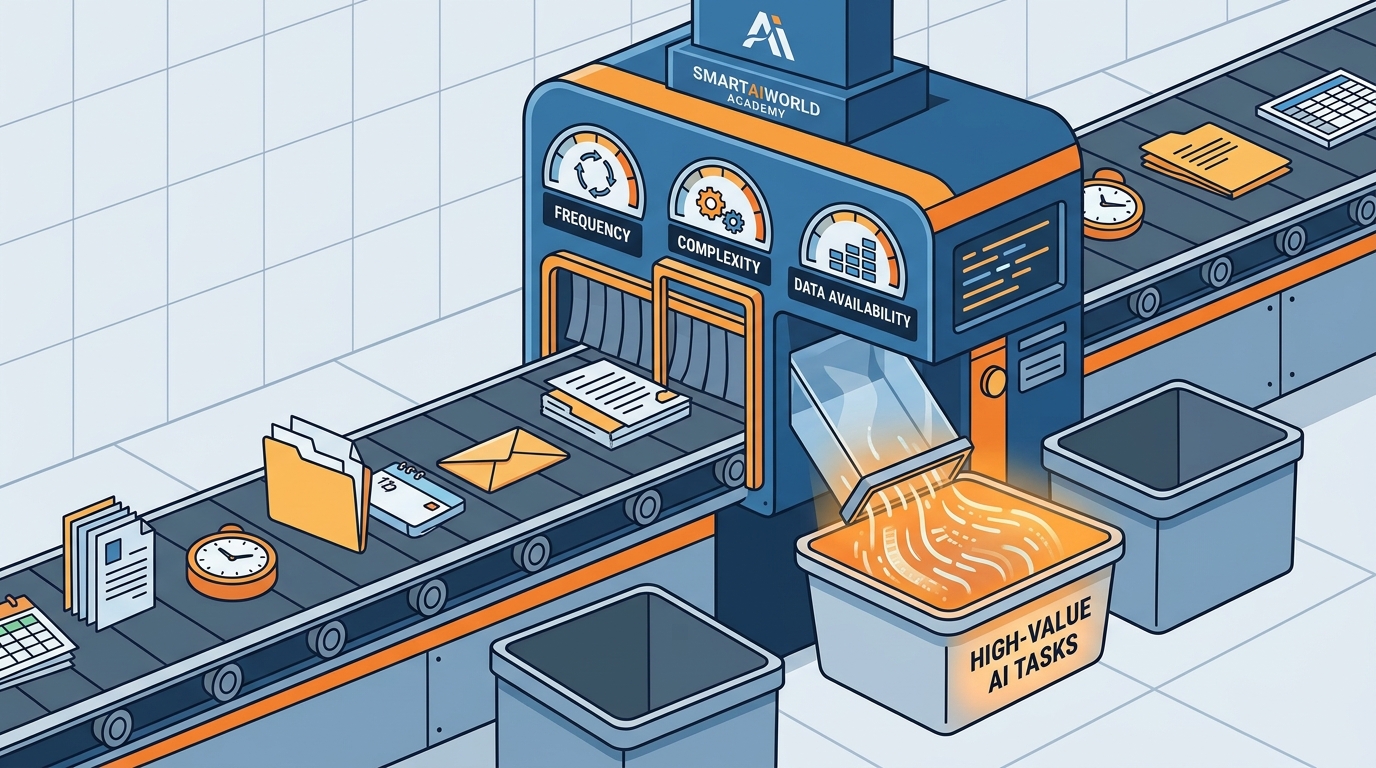
Identify high-value AI tasks by evaluating frequency, complexity, and data availability. This guide provides a structured framework for assessing your daily workflow. It covers specific evaluation criteria and a practical pilot testing approach. You will learn how to move from curiosity to confident application without technical overload.
Task Evaluation Criteria
Not every task benefits from artificial intelligence. A task evaluation framework is a systematic method for determining if a specific job function can be improved by machine learning models. You must look beyond simple time savings. The goal is to find tasks where AI adds clarity, speed, or consistency.
Frequency and Repetition
High-frequency tasks are prime candidates for automation. If you perform a task more than three times a week, it consumes significant cognitive load. AI excels at repetitive patterns. It can handle data entry, email triage, or report generation. These tasks often follow a predictable structure. This predictability allows models to learn and improve over time.
Complexity and Cognitive Load
Complex tasks require careful judgment. AI can assist with the initial draft or data synthesis. It cannot replace human accountability for final decisions. Tasks involving high stakes or ethical considerations need human oversight. You should use AI to reduce the time spent on research. This frees up your mind for strategic thinking. The complexity of the input data matters. Structured data is easier for AI to process than unstructured text.
Data Availability and Quality
AI systems rely on data. If your task requires proprietary or sensitive information, you must consider data privacy. You need clean, organized inputs to get reliable outputs. Garbage in, garbage out. Evaluate if you have the necessary context to prompt the model effectively. If the data is scattered across multiple platforms, the setup cost may be too high. Start with tasks where the data is already centralized.
| Task Type | AI Suitability | Reason |
|---|---|---|
| Email Triage | High | Repetitive, text-based, low risk |
| Financial Forecasting | Medium | Requires human validation, complex data |
| Creative Strategy | Low | Highly subjective, requires human insight |
| Data Cleaning | High | Rule-based, high volume, low risk |
Pilot Testing Approach
A pilot test is a small-scale experiment to validate an AI workflow before full deployment. You should never roll out AI across your entire team immediately. Start with one specific task. Define clear success metrics. Measure the time saved and the quality of the output. This approach minimizes risk and builds confidence.
Defining the Pilot Scope
Choose one task for your pilot. Set a timeframe of two to four weeks. Assign a small group of users to test the workflow. Ensure they have access to the necessary tools. Document the process. Record any errors or inconsistencies. This documentation helps you refine the prompts and instructions. A narrow scope makes it easier to identify what works and what does not.
Measuring Success
Establish baseline metrics before the pilot. How long does the task currently take? What is the error rate? Compare these numbers to the AI-assisted results. Quality is just as important as speed. If the AI output requires extensive editing, it may not be worth the effort. Use a simple scoring system. Rate the output on accuracy, completeness, and tone. This quantitative data supports your decision to scale or abandon the workflow.
Iterating and Scaling
Review the pilot results with your team. Gather feedback on usability and reliability. Adjust the prompts based on the errors you identified. If the pilot is successful, expand the scope. Train additional users. Create standard operating procedures. Document the workflow for future reference. This iterative process ensures that your AI implementation remains effective as your needs evolve.
Key Takeaways
- Use a structured framework to evaluate task frequency, complexity, and data quality.
- High-frequency, repetitive tasks are the best initial candidates for AI.
- Always maintain human oversight for high-stakes or ethical decisions.
- Start with a small-scale pilot to measure time savings and quality.
- Document your workflow to create a repeatable system.
- Iterate on prompts based on pilot feedback before scaling.
- Focus on practical application rather than theoretical knowledge.
Frequently Asked Questions
What is the first step in evaluating a task for AI?
The first step is to identify the task's frequency and repetition. If you perform the task multiple times a week, it is a strong candidate. Assess the structure of the data involved. Structured data is easier for AI to process.
How long should a pilot test last?
A pilot test should last two to four weeks. This duration provides enough data to measure consistency. It allows users to become comfortable with the workflow. You can then evaluate the results and make adjustments.
Can AI replace human judgment in complex tasks?
No, AI should not replace human judgment in complex tasks. It can assist with research and drafting. However, final decisions require human accountability. Use AI to reduce the time spent on initial analysis. Keep the final review in human hands.
What metrics should I track during a pilot?
Track time saved, error rate, and output quality. Compare these metrics to your baseline. Use a simple scoring system for quality. This data helps you determine if the workflow is worth scaling.
How do I handle sensitive data in AI workflows?
Ensure you have proper data privacy controls in place. Avoid inputting sensitive information into public AI models. Use enterprise-grade tools with strict security protocols. Verify that your data is not used for training purposes.
What if the AI output is not accurate?
Refine your prompts to provide more context and constraints. Check the quality of your input data. If the output remains inaccurate, the task may not be suitable for AI. Consider keeping the task manual or using a different tool.
How do I scale a successful pilot?
Document the workflow and create standard operating procedures. Train additional users on the process. Monitor the results closely during the expansion. Continue to iterate on the prompts based on new feedback.
Conclusion
Identifying the right tasks for AI requires a disciplined approach. Use the evaluation criteria to filter your workflow. Implement a pilot test to validate your assumptions. This method ensures that you build useful systems rather than chasing hype. SmartAIWorld Academy provides a structured path for beginners to master these skills. You can start with their free AI starter kit to explore practical prompts. Visit the AI resources page for more guidance. Learn more about the founder's approach on the about page. Begin your journey to confident AI application today.