

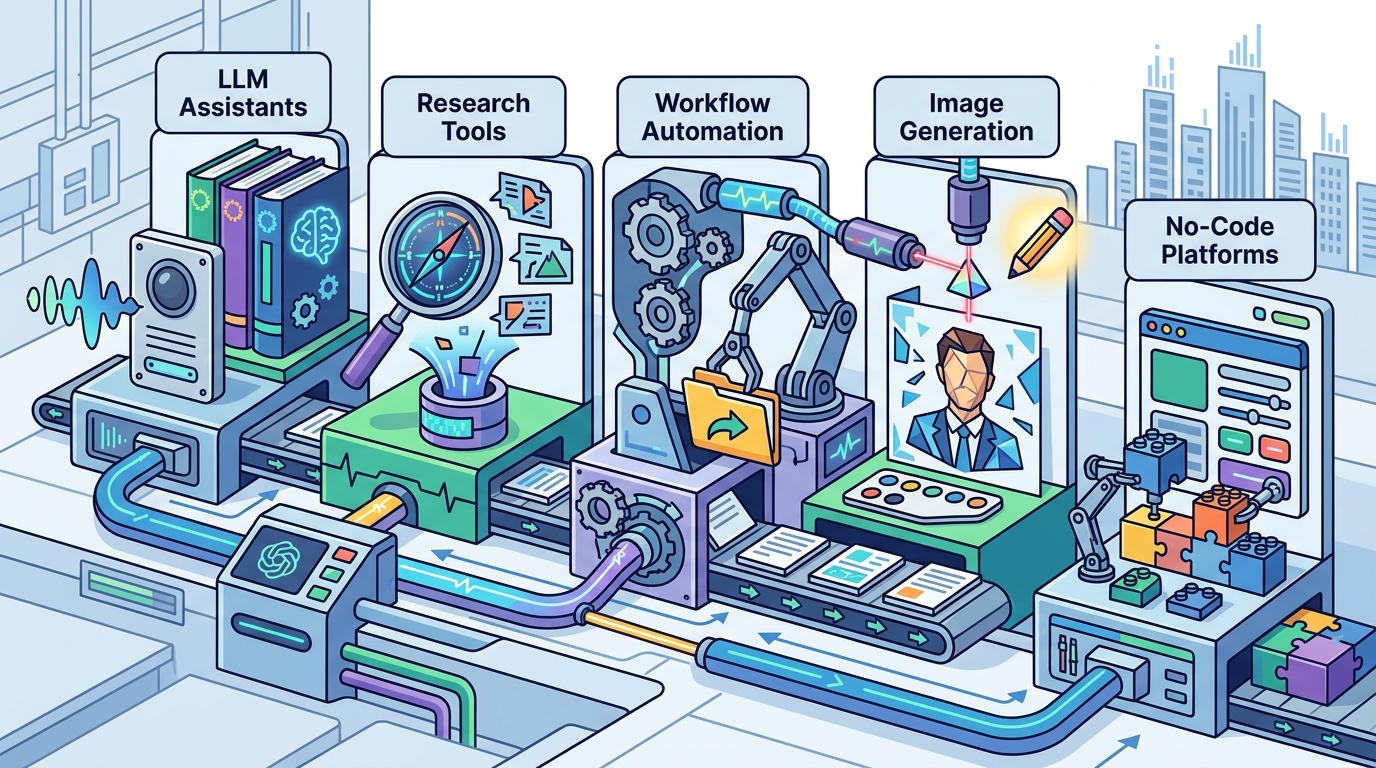
SmartAIWorld Academy recommends a focused stack of five tool categories: LLM assistants, research tools, workflow automation, image generation, and no-code platforms. This guide details how to select and apply these tools for real work tasks. It covers specific use cases, integration strategies, and safety protocols for professional environments. according to AI hiring tools For additional details, review the SmartAIWorld Practical AI Skills.
LLM Assistants
Large Language Model (LLM) assistants are conversational AI systems designed to process natural language inputs and generate text, code, or structured data outputs. They serve as the primary interface for most professional AI tasks. Professionals use these tools for drafting, summarizing, and logical reasoning. The key is treating the AI as a junior colleague who requires clear context and constraints.
Selection Criteria
When choosing an LLM assistant, prioritize context window size and instruction following. A larger context window allows the model to process longer documents without losing track of earlier details. Instruction following ensures the model adheres to specific formatting or tone requirements. Look for tools that support system prompts to maintain consistent behavior across sessions.
Professional Use Cases
Common professional applications include email triage, meeting note summarization, and code review. For email triage, the assistant can categorize messages by urgency and draft replies. For meeting notes, it can extract action items and owners from raw transcripts. For code review, it can identify potential bugs or suggest refactoring opportunities. Always review the output for accuracy before sharing it with stakeholders.
Research Tools
AI-powered research tools are specialized applications that help users find, synthesize, and cite information from vast datasets. They reduce the time spent searching for relevant sources and verifying facts. These tools are essential for market analysis, competitive intelligence, and academic work. They help professionals move from raw data to actionable insights quickly. according to AI in the
Synthesis and Summarization
Modern research tools can summarize multiple documents into a single coherent narrative. They identify key themes and contradictions across sources. This capability is valuable when analyzing industry reports or legal documents. The tool should provide citations for every claim to maintain transparency and trust.
Fact-Checking and Verification
Workflow Automation
Workflow automation is the use of software to execute repetitive business processes with minimal human intervention. It connects different applications and triggers actions based on specific events. This category includes tools that can read emails, update spreadsheets, and send notifications. The goal is to eliminate manual data entry and reduce the risk of human error.
Trigger-Based Systems
Effective automation relies on clear triggers. A trigger is an event that starts the workflow, such as a new form submission or a calendar invite. The workflow then executes a series of steps, such as creating a task in a project management tool. Each step should have a defined input and output. This structure makes the workflow easy to debug and maintain.
Human-in-the-Loop Design
Not all tasks should be fully automated. Human-in-the-loop design requires a person to review and approve the AI's output before it is finalized. This is crucial for high-stakes decisions or creative work. The automation handles the heavy lifting, while the human provides judgment and quality control. This balance ensures efficiency without sacrificing accuracy.
Image Generation
Generative image tools are AI models that create visual content from text descriptions. They are used for marketing materials, presentations, and conceptual design. These tools allow non-designers to create professional-looking visuals quickly. They help teams iterate on ideas without waiting for a designer's availability.
Marketing and Branding
Marketing teams use image generation to create social media graphics, blog headers, and ad creatives. The tool can generate variations of a concept for A/B testing. This speed allows marketers to test different visual approaches and find what resonates with the audience. Consistency is key, so users should develop a style guide for their generated images.
Conceptual Design
Product teams use these tools to visualize concepts before building prototypes. They can generate mockups of user interfaces or physical products. This helps in communicating ideas to stakeholders and gathering feedback early. The images are not final designs but serve as a starting point for discussion. They help align the team on the visual direction.
No-Code Platforms
No-code platforms are software environments that allow users to build applications and workflows using visual interfaces instead of writing code. They democratize software development by enabling non-technical professionals to create custom tools. These platforms include drag-and-drop builders, logic blocks, and pre-built integrations. They are ideal for creating internal tools, customer portals, and data dashboards.
Building Internal Tools
Business teams use no-code platforms to build internal tools that solve specific problems. For example, a sales team might build a lead qualification tool that scores leads based on predefined criteria. The tool can integrate with the CRM and send notifications to the right sales rep. This eliminates the need for a developer to build a custom solution. The business team can maintain and update the tool as needs change. according to Python Data Science
Data Dashboards and Reporting
No-code platforms allow users to create data dashboards without writing SQL or Python. They connect to various data sources and visualize the data in charts and tables. This is useful for tracking key performance indicators (KPIs) and monitoring business health. The dashboards can be shared with stakeholders in real-time. This promotes data-driven decision-making across the organization.
Tool Comparison Table
| Tool Category | Primary Function | Best For | Key Skill Required |
|---|---|---|---|
| LLM Assistants | Text generation and reasoning | Drafting, summarizing, coding | Prompt engineering |
| Research Tools | Information synthesis and citation | Market analysis, fact-checking | Critical evaluation |
| Workflow Automation | Process execution and integration | Repetitive tasks, data entry | Process mapping |
| Image Generation | Visual content creation | Marketing, conceptual design | Visual direction |
| No-Code Platforms | Application building | Internal tools, dashboards | Logic and design |
Key Takeaways
- LLM assistants are the core interface for most professional AI tasks, requiring clear context and constraints.
- Research tools help synthesize information and verify facts, but users must still review critical claims.
- Workflow automation eliminates repetitive tasks but should include human review for high-stakes decisions.
- Image generation tools enable non-designers to create professional visuals for marketing and design.
- No-code platforms allow business teams to build custom tools and dashboards without writing code.
- Each tool category serves a distinct purpose, and a balanced stack covers most professional needs.
- Security and privacy must be considered when selecting tools, especially for sensitive data.
- Continuous learning is essential as AI tools evolve rapidly.
Frequently Asked Questions
What is the best LLM assistant for professionals?
There is no single best assistant; it depends on your specific needs. Look for tools with large context windows and strong instruction following. Test a few options with your actual work tasks to see which performs best.
How do I ensure data privacy when using AI tools?
Choose tools that offer enterprise-grade security and data privacy guarantees. Avoid uploading sensitive data to consumer-grade tools. Review the tool's privacy policy and data retention practices before use.
Can I automate complex workflows without coding?
Yes, no-code platforms allow you to build complex workflows using visual interfaces. You can connect different applications and define logic without writing code. This makes automation accessible to non-technical professionals.
Are AI-generated images suitable for professional use?
Yes, but they require careful review. Check for artifacts, consistency, and brand alignment. Use them as a starting point for design, not as a final product. Always ensure you have the rights to use the generated images.
How do I start learning these tools?
Start with one tool category and apply it to a real work task. Practice regularly and document your results. Consider taking a structured course to learn best practices and avoid common pitfalls.
What is the role of human review in AI workflows?
Human review is essential for maintaining quality and accuracy. It ensures that the AI's output aligns with business goals and ethical standards. It also helps catch errors and hallucinations that the AI might miss.