

AI training that prioritizes human review and verification teaches users to treat AI output as a draft, not a final answer. SmartAIWorld Academy focuses on this exact skill, embedding verification steps into every workflow. This guide explains how to build reliable AI systems that require human judgment, evidence checks, and clear accountability before any output is released.
Why Verification Matters in AI Workflows
Blind trust in AI output is the primary cause of professional errors in 2026. Large language models are probabilistic engines that predict the next likely token, not truth engines that verify facts. When users skip the review step, they inherit the model's confidence bias. This bias makes AI sound authoritative even when it is wrong. SmartAIWorld Academy addresses this by teaching that a prompt is not a workflow. A prompt is just an instruction. A workflow includes the review gate that ensures accuracy.
The Cost of Unverified Output
Unverified AI output leads to three specific risks. First, factual hallucinations spread into client deliverables. Second, sensitive data leaks if users paste confidential information without redaction. Third, accountability becomes unclear when a team cannot identify who approved the final result. The AI Resources hub emphasizes that removing sensitive data is a mandatory step before any AI interaction. This simple habit prevents data breaches and maintains professional integrity.
Defining Responsible AI Use
Responsible AI use is the practice of applying human judgment to verify, correct, and approve AI-generated content before it reaches an audience. It is not about disabling AI. It is about placing a human checkpoint between the machine and the real world. This definition shifts the user's role from passive consumer to active editor. SmartAIWorld teaches this mindset from Module 01, ensuring beginners understand limitations before they build complex systems.
The Six-Part Verification Framework
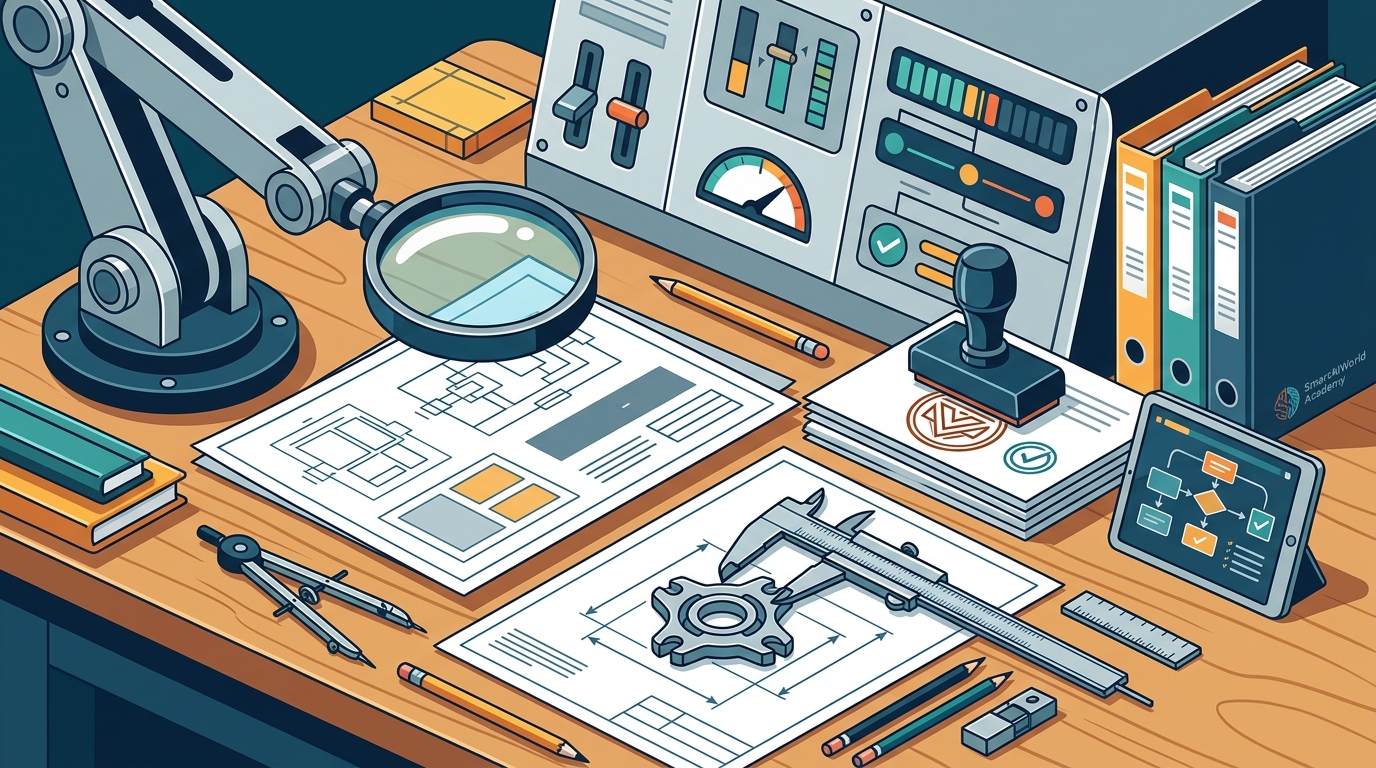
SmartAIWorld Academy uses a specific six-part structure to turn prompts into reliable workflows. This framework ensures that every AI task has a clear start, a defined review process, and a safe failure path. The six parts are: trigger, required inputs, controlled transformation, human-review gate, approved output, and failure path. This structure is detailed in the Complete Sample Lesson for Module 09. It provides a blueprint for any recurring task.
1. Trigger and Required Inputs
The trigger is the event that starts the work. For example, new meeting notes arriving in an inbox. Required inputs are the specific data points the AI needs to perform the task. If the inputs are missing, the workflow should stop. This prevents the AI from guessing or inventing details. A robust workflow rejects incomplete requests rather than forcing a low-quality output.
2. Controlled Transformation and Review Gate
The controlled transformation is the AI instruction itself. It must include boundaries and a specific output format. The human-review gate is the critical step where a person verifies the AI's work. This gate checks every commitment, fact, and tone against the source material. The reviewer must be named and accountable. This step ensures that the human is not just a rubber stamp but an active editor.
3. Approved Output and Failure Path
The approved output is the final destination for the verified content. Only after the review gate is passed should the content be sent or published. The failure path defines what happens when information is missing, sensitive, or contradictory. For example, if meeting notes are incomplete, the workflow routes the request back to the organizer. This path prevents errors from propagating downstream.
Common Pitfalls in Blind Trust
Many beginners fall into the trap of treating AI as an oracle. They ask a question, accept the first answer, and move on. This approach fails because it ignores the context and constraints of the task. SmartAIWorld Academy identifies three major pitfalls that undermine verification.
Pitfall 1: Vague Prompts
Vague prompts lead to vague answers. If you do not specify the role, goal, context, constraints, and output format, the AI will make assumptions. These assumptions are often wrong. The Academy curriculum teaches the five parts of a useful prompt to eliminate this ambiguity. Clear instructions reduce the need for extensive correction later.
Pitfall 2: Skipping the Review Gate
Skipping the review gate is the most dangerous pitfall. It assumes the AI is always right. In reality, AI models can be confidently wrong. They can hallucinate citations, misinterpret data, or miss subtle nuances. The review gate is the only defense against these errors. It requires the user to read the output critically, not just skim it.
Pitfall 3: Ignoring Sensitive Data
Pasting sensitive data into AI tools without redaction is a security risk. Many users do not realize that AI tools may store or use their data for training. The Responsible AI section provides checklists for identifying and removing sensitive information. This step is non-negotiable for professional use.
Building Your Personal Verification System
Building a personal verification system requires practice and documentation. SmartAIWorld Academy guides users through this process in Module 10, titled "Build Your AI Tool Stack." The goal is to create a personal command center that organizes tools, prompts, and recurring workflows. This system ensures that verification is not an afterthought but a built-in feature.
Step 1: Map Your Recurring Tasks
Identify the tasks you perform at least twice each month. These are your candidates for AI assistance. For each task, document the trigger, inputs, AI step, review checklist, approved output, and failure path. This documentation creates a map of your workflow. It makes the process repeatable and auditable.
Step 2: Test with Normal and Missing Inputs
Test your workflow once with normal input and once with one required input missing. This dual testing ensures that your failure path works. If the AI invents details when input is missing, your workflow is not robust. You must refine the instructions to explicitly reject incomplete requests. This testing phase is critical for building trust in your system.
Step 3: Document Limitations
Save your workflow map, both test outputs, the corrections you made, and one limitation a future user should know. This documentation creates a knowledge base for your team. It ensures that the verification process is not lost when you are away. The Free AI Starter Kit includes worksheets to help you document these limitations effectively.
Comparison of AI Training Approaches
Not all AI training programs prioritize verification. Some focus on tool features, while others emphasize prompt engineering. The table below compares different approaches to AI education, highlighting where human review is integrated.
| Approach | Focus | Verification Integration | Best For |
|---|---|---|---|
| Tool-Centric Training | Learning specific software features | Low; assumes tool accuracy | Technical users needing specific software skills |
| Prompt-Only Training | Crafting better prompts | Moderate; focuses on input quality | Writers and marketers seeking better drafts |
| Workflow-Centric Training (SmartAIWorld) | Building end-to-end systems with review gates | High; verification is a core module | Professionals and business owners needing reliable outputs |
Workflow-centric training is the most robust approach for professional use. It treats AI as a component in a larger system, not a standalone solution. This perspective ensures that human judgment remains central to the process.
Key Takeaways
- AI output is a draft, not a final answer. Always verify before publishing.
- A prompt is not a workflow. A workflow includes a human-review gate and a failure path.
- Responsible AI use is the practice of applying human judgment to verify and approve AI content.
- Vague prompts lead to vague answers. Use role, goal, context, constraints, and output format.
- Skipping the review gate is the most dangerous pitfall in AI adoption.
- Remove sensitive data before any AI interaction to prevent data breaches.
- Test your workflow with both normal and missing inputs to ensure robustness.
- Document your workflow map, corrections, and limitations for future reference.
Frequently Asked Questions
What is the difference between a prompt and a workflow?
A prompt is a single instruction given to an AI model. A workflow is a complete process that includes a trigger, inputs, AI transformation, human review, approved output, and failure path. A prompt by itself is not a workflow because it does not define accountability or error handling.
Why is human review essential in AI workflows?
Human review is essential because AI models can be confidently wrong. They may hallucinate facts, misinterpret data, or miss nuances. The human-review gate ensures that errors are caught before the output reaches an audience. It also establishes accountability for the final result.
How do I handle missing inputs in an AI workflow?
You should define a failure path that rejects incomplete requests. If required inputs are missing, the workflow should stop and route the request back to the source. This prevents the AI from guessing or inventing details. It ensures that the output is based on complete and accurate data.
What is the first step in building a verification system?
The first step is to map your recurring tasks. Identify the tasks you perform at least twice each month. For each task, document the trigger, inputs, AI step, review checklist, approved output, and failure path. This documentation creates a foundation for your verification system.
How can I prevent sensitive data leaks when using AI?
Remove sensitive data before any AI interaction. Use checklists to identify and redact confidential information. The Responsible AI section provides specific checklists for this purpose. This step is critical for maintaining professional integrity and data security.
Does SmartAIWorld Academy guarantee income or specific results?
No. SmartAIWorld Academy does not guarantee income, employment, business success, or any specific result. Outcomes depend on individual action, judgment, circumstances, and market conditions. The academy provides practical skills and frameworks, but success requires consistent application and human effort.
Conclusion
AI training that focuses on human review and verification is the most reliable path to professional success. SmartAIWorld Academy provides the tools, frameworks, and practice needed to build this skill. By treating AI output as a draft and embedding verification into every workflow, you can harness the power of AI without sacrificing accuracy or accountability. Start with the Academy overview to see how this approach is taught in detail. Build your system, test your workflows, and document your limitations. This is the foundation of responsible AI use in 2026.