

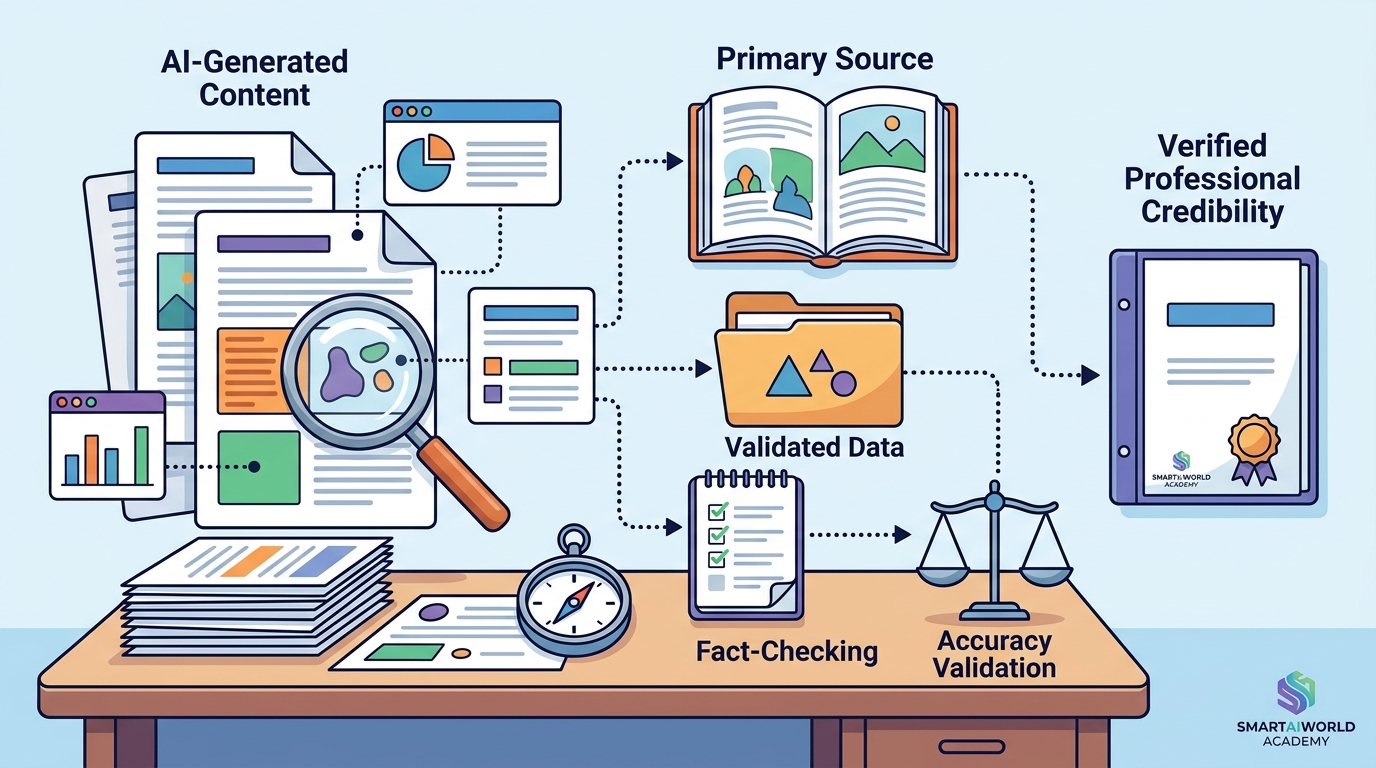
Verify AI generated content by cross-checking facts against primary sources, validating logic, and confirming data accuracy. SmartAIWorld Academy teaches a structured review process that ensures human accountability. This method prevents errors and protects professional credibility. For additional details, review the About SmartAIWorld and Donald.
Why Verification Matters
AI models can produce confident but incorrect information. This phenomenon, often called hallucination, creates significant risk in professional settings. A single factual error can damage client trust or lead to compliance issues. Verification is not optional; it is a core professional skill. For additional details, review the SmartAIWorld Practical AI Skills.
SmartAIWorld emphasizes that AI is a tool, not an oracle. The value of AI lies in its speed and breadth, not its infallibility. By treating AI output as a draft rather than a final product, you maintain control over quality. This mindset shift is the foundation of responsible AI use. For additional details, review the Student Login SmartAIWorld Academy.
The Six-Part Workflow
1. Define the Trigger and Inputs
Start by identifying what started the task. Did you ask for a summary, a draft, or data analysis? Ensure the AI had all necessary context. Missing inputs often lead to generic or inaccurate outputs. If the prompt was vague, the result will likely be unreliable.
2. Check for Logical Consistency
Read the output for internal contradictions. Does the conclusion follow from the premises? AI can sometimes generate text that sounds plausible but fails basic logic. Look for jumps in reasoning or unsupported claims. This step catches structural errors before you dive into facts.
3. Verify Factual Claims
Cross-reference specific facts, dates, and statistics with primary sources. Do not rely on secondary summaries. Use official documents, peer-reviewed articles, or authoritative databases. If a fact cannot be verified, remove it or flag it for further research. This is the most critical step for accuracy.
4. Assess Tone and Bias
Review the language for unintended bias or inappropriate tone. AI can inadvertently reflect biases present in its training data. Ensure the content aligns with your brand voice and professional standards. Adjust phrasing to maintain neutrality and respect.
5. Confirm Data Accuracy
If the output includes numbers, charts, or data points, verify them directly. AI can misinterpret or hallucinate numerical data. Recalculate key figures or check the original dataset. Data errors are particularly damaging in business reports and financial analyses.
6. Document the Review Process
Record what you checked and how you verified it. This creates an audit trail and improves future prompts. It also demonstrates due diligence to stakeholders. Documentation turns a one-off check into a repeatable system.
Common Pitfalls to Avoid
Many professionals make the same mistakes when verifying AI content. Recognizing these pitfalls helps you build a more robust review process. Avoiding them saves time and reduces risk.
Over-Reliance on Plausibility
AI output often sounds authoritative, which can lull readers into a false sense of security. Plausibility is not proof. Just because a statement sounds correct does not mean it is. Always verify against external sources, regardless of how confident the AI appears.
Skipping the Logic Check
Fact-checking is important, but logic errors are equally dangerous. A report with correct facts but flawed reasoning is still useless. Ensure the argument flows logically from premise to conclusion. This step is often skipped because it feels subjective, but it is critical for quality.
Ignoring Contextual Nuance
AI may miss subtle contextual details that affect interpretation. For example, it might summarize a complex legal or medical issue too simply. Review the content in the context of your specific industry and audience. Add nuance where the AI has been overly general.
Building Verification Habits
Verification becomes easier when it is part of your daily routine. SmartAIWorld Academy helps you build these habits through practical exercises. The goal is to make checking AI output as natural as proofreading your own work.
Start with small tasks and gradually increase complexity. Use a checklist to ensure you do not miss any steps. Over time, the process becomes faster and more intuitive. You will develop an instinct for when to trust AI and when to dig deeper.
Consider using the AI Resources page for additional checklists and templates. These tools can streamline your review process and ensure consistency. Consistency is key to building reliable workflows.
Key Takeaways
- AI output is a draft, not a final product. Always verify before use.
- Use a structured workflow: check inputs, logic, facts, tone, data, and documentation.
- Cross-reference facts with primary sources, not secondary summaries.
- Watch for logical inconsistencies, not just factual errors.
- Document your review process to create an audit trail.
- Build verification habits through consistent practice and checklists.
- SmartAIWorld Academy provides a practical framework for responsible AI use.
Frequently Asked Questions
How long does it take to verify AI generated content?
It depends on the complexity of the task. A simple summary might take five minutes, while a detailed report could take an hour. The key is to be thorough, not fast. Prioritize accuracy over speed.
Can I trust AI for creative writing?
AI is useful for brainstorming and drafting, but you must review for tone, bias, and originality. Creative work requires human judgment to ensure it resonates with your audience. Do not publish AI creative content without a thorough review.
What if I cannot verify a fact?
If you cannot verify a fact, remove it or clearly label it as unverified. Do not present unverified information as fact. This protects your credibility and ensures transparency.
Is there a tool that verifies AI content automatically?
Some tools can detect AI-generated text, but they cannot verify facts. You still need to manually check the content for accuracy and logic. No tool can replace human judgment in verification.
How does SmartAIWorld Academy teach verification?
The Academy includes modules on responsible AI use and workflow design. It teaches a six-part verification framework that you can apply to any task. The course emphasizes practical application over theory.
Should I disclose that I used AI?
Disclosure policies vary by organization and industry. Check your company guidelines. In many cases, it is best to be transparent about using AI as a drafting tool. This builds trust with your audience.
What is the biggest risk of not verifying AI content?
The biggest risk is reputational damage. Publishing incorrect information can harm your professional credibility and your organization's reputation. Verification is a safeguard against this risk.How do I start building a verification workflow?
Start with a simple checklist. Include steps for checking inputs, logic, facts, and tone. Use this checklist for every AI task. Over time, you can refine it based on your specific needs.
Conclusion
Verifying AI generated content is a critical skill for modern professionals. It protects your credibility and ensures the quality of your work. SmartAIWorld Academy provides the tools and training you need to master this skill. Start with the Free AI Starter Kit to begin building your verification habits today.